Orthodontics
Orthodontics for teenagers: what is the right age?
First check-up, signs that mean you should see a dentist, choosing the appliance, daily life with braces and the parents' role during treatment.

Reviewed by Dr Badr Salhi, dental surgeon
Published on 27 August 2026 · 9 min read

“Does my child need a brace, and when?” It is one of the questions parents ask most often. In orthodontics, adolescence is often a good time to act, but an earlier first check-up means certain problems are not missed. Here are the useful pointers on orthodontics for teenagers, from the first examination to retention.
Contents
Why teeth come in crooked
Teeth position themselves according to the size of the jaws, the size of the teeth themselves and the forces exerted by the tongue, lips and cheeks. A discrepancy can be hereditary, such as a narrow jaw or wide teeth. It can also be encouraged by habits: prolonged thumb-sucking, a dummy used too late, mouth breathing, a tongue that pushes against the teeth when swallowing. A baby tooth lost too early, for example because of a cavity, also lets its neighbours slide into the gap.
A first check-up at around 7
At this age, the first permanent teeth have come through and the jaws are growing. An examination makes it possible to spot early a discrepancy between the jaws, a tooth coming in badly or a habit that is changing the shape of the mouth. Most children need no treatment at this stage: simple monitoring is enough. In a few cases, a short, early treatment makes things simpler later, for example widening an upper jaw that is too narrow while it is still growing. The American Association of Orthodontists also recommends a first orthodontic check-up no later than age 7.
Children’s check-ups are presented on the Children’s dentist page.
Orthodontics for teenagers: most often between 11 and 14
Most treatments start when almost all the permanent teeth have come through, usually between 11 and 14. Growth that is still active helps correct certain discrepancies, and teeth move easily. The exact timing depends on each child’s dental maturity more than on their age: two teenagers of the same age can be several years apart in how their teeth come through.
| Age | What happens | What is done |
|---|---|---|
| Around 7 | First permanent teeth, active growth | First check-up, monitoring |
| 7 to 10 | Mixed teeth | Early treatment if needed, short |
| 11 to 14 | Last baby teeth replaced | Full treatment, the most common |
| 15 and over | Growth slows down | Treatment still possible |
Orthodontics for teenagers: signs that call for a consultation
- teeth that overlap or lack space;
- upper teeth that stick out a lot, or are hidden behind the lower ones;
- teeth that do not touch at the front when the mouth is closed;
- a jaw that shifts to one side;
- baby teeth that fall out very early or very late;
- difficulty chewing, or constant mouth breathing.
Just one of these signs is enough to ask for an opinion. A check-up does not necessarily lead to treatment.
The orthodontic assessment
Before any treatment in teenage orthodontics, a full assessment is carried out: examination of the teeth, jaws and face, photos, impressions or a digital impression, and X-rays. The panoramic X-ray shows all the teeth, including those that have not yet come through and the wisdom teeth as they form. A side X-ray may complete the assessment to measure the position of the jaws. The gums and any cavities are also checked, and treated before the brace is fitted.

From this assessment, our team’s orthodontist explains what she sees, whether to treat now or wait, and what options are possible.
Orthodontics for teenagers: braces or aligners?
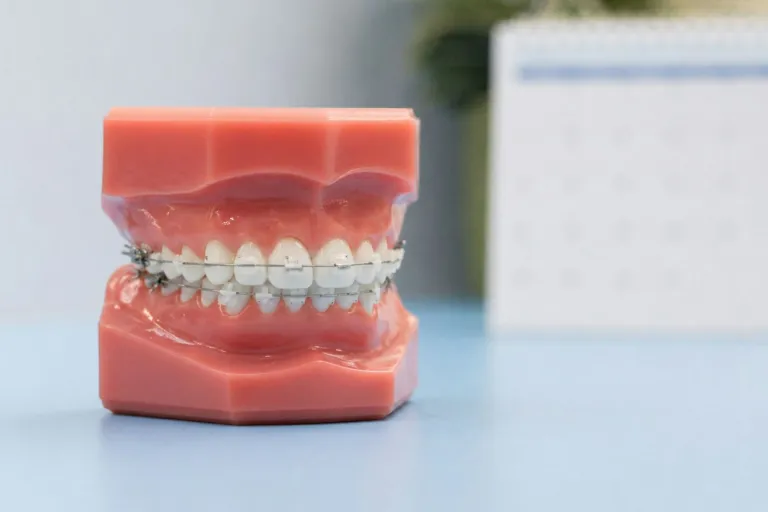
Braces work all the time and do not depend on the teenager’s discipline. They can be metal or ceramic, which is more discreet. They require rigorous hygiene and a few precautions with food.
Clear aligners are discreet and come out for eating and brushing. They only work if they are worn about 22 hours a day, which requires a motivated teenager and attentive follow-up from the parents.
The right appliance is the one the teenager will wear and look after properly: it is discussed with them, not just with their parents.
Our article aligners or braces details the differences between the two techniques, and our article clear aligners explains how they work.
Other appliances in children’s orthodontics
Before adolescence, other appliances may be used, often for a short time:
- a removable appliance, a resin plate worn at home and at night, which guides how certain teeth come through;
- a palatal expander, fixed to the palate, which widens an upper jaw that is too narrow while growth allows it;
- a space maintainer, which keeps the space of a baby tooth lost too early.
These appliances in children’s orthodontics sometimes prepare the ground: treatment in adolescence is then shorter, or simpler. A dental brace of this type is only suggested if the assessment justifies it.
On video: how a dental brace works
This educational animation presents the parts of a fixed brace and the role each one plays in moving the teeth.
Daily life with a dental brace
The first few days
After braces are fitted or a new aligner is started, the teeth are tender for two to four days. Soft food and cool drinks help. Orthodontic wax, placed on a bracket that rubs, protects the cheek while it gets used to it. Rinsing with warm salt water soothes small sore spots on the cheeks.
Food
With braces, avoid very hard food (whole nuts, ice cubes, hard crusts), which can detach the brackets, and sticky food (toffees, chewing gum), which clings to the wire. Hard fruit and vegetables are eaten cut into small pieces: apples and carrots cut into thin slices stay on the menu.
Brushing
Plaque that sits around the brackets leaves white marks on the enamel, which can remain after treatment. Brushing is done after every meal, with a suitable brush and interdental brushes to clean under the wire.

Sport and music
A mouthguard is recommended for contact sports. For wind instruments, a few days of adjustment are usually enough.
Length and appointments
With braces, teenage orthodontics often takes 12 to 24 months, depending on complexity, with regular check-ups at the practice, about every four to eight weeks. The plan, estimated length and price are explained to you before starting.
The parents’ role
In orthodontics for teenagers, parents have a practical role:
- check brushing, especially with braces;
- remind them to wear the aligners or prescribed elastics;
- provide protection for contact sports;
- let the practice know if a bracket comes off or a wire hurts;
- keep check-up appointments, even during exam periods;
- prepare a small kit for school, with a toothbrush, interdental brushes and wax.
Parents’ support also matters emotionally: a brace can bother a teenager at first. Encouraging them, without making a drama of it, helps them stick with it.
After treatment: retention
A retainer stabilises the result: a wire bonded behind the teeth or an aligner worn at night. It is important for teenagers, because growth and the arrival of wisdom teeth can still make teeth move. The NHS also points out that a retainer is needed after the brace is removed, to stop the teeth moving back to their original position.
Orthodontics for teenagers in Casablanca: the first consultation
At the CaliSmile Dental Centre, in the Californie district, the first consultation takes place with the teenager and at least one parent. Our team’s orthodontist examines the teeth, explains what she sees in simple words and tells you whether to treat now, later, or simply monitor. The appointment is also a chance for the teenager to ask their own questions: how long it lasts, what it looks like, what changes day to day. To find out more about the techniques, length of treatment and indicative prices, see the Dental braces and Clear aligners pages.
Frequently asked questions: orthodontics for teenagers
Is it too late for a brace at 16 or 17?
No. Growth slows down, which makes some jaw discrepancies harder to correct, but straightening the teeth remains entirely possible, at any age.
Does a dental brace hurt?
It causes discomfort for a few days after fitting and after each adjustment. It is not severe pain: soft food and, if needed, a simple painkiller are enough.
Can my child play sport with braces?
Yes, with a mouthguard for contact sports. For other sports, no particular precaution is needed.
Do teeth have to be removed for orthodontic treatment?
Not systematically. When space is very short, removing certain teeth may be suggested. Other solutions sometimes exist, such as widening a jaw. The assessment helps choose.
Do braces damage the teeth?
No, if brushing is rigorous. White marks come from plaque left around the brackets, not from the braces themselves. That is why hygiene is a central part of treatment.
Will wisdom teeth spoil the result?
They can push the other teeth if space is short. They are monitored on X-rays during and after treatment, and the retainer helps keep the alignment.
How long must the retainer be worn?
For a long time: a bonded retainer often stays for several years, and the night aligner is worn at a rhythm set by our team’s orthodontist. Teeth tend to move throughout life.
This article gives general information; it does not replace a consultation.