
Orthodontics
Dental braces in Casablanca
A fixed appliance, in metal or tooth-coloured ceramic, that straightens the teeth day and night, without you having to remember to wear it. Before starting, you know the estimated length, the check-up schedule and the cost.
A fixed appliance, in metal or ceramic, that straightens the teeth day and night.

Reviewed by Dr Badr Salhi, dental surgeon
6 min read
The treatment path
12 to 24
months of treatment, depending on the case
months
4–8 wks
between two check-ups at the practice
between two check-ups
24/7
the appliance works continuously, never removed
continuously
Reviewed by Dr Badr Salhi, dental surgeon
6 min read
The essentials in 30 seconds
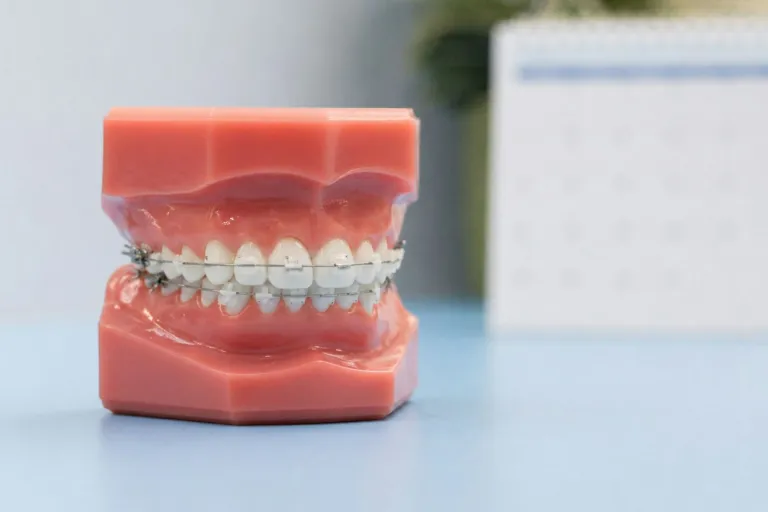
Braces are small brackets bonded to the teeth and linked by a wire, which the dentist adjusts at each check-up to move the teeth little by little.
They stay in place day and night: the treatment progresses without depending on your discipline. They come in metal or in tooth-coloured ceramic. Treatment usually lasts 12 to 24 months, with a check-up every four to eight weeks. After fitting and after each adjustment, the teeth are tender for a few days.
Who is it for?
The examination, photos and X-ray show whether braces suit your case, or whether aligners are enough.
Suitable if
- Teeth that are very rotated, tilted or clearly overlapping
- A bite misalignment to be corrected precisely
- A teenager who would find a removable appliance hard to wear
- You prefer an appliance that is never taken out
Not suitable if
- Unstabilised gum disease: we treat it first
- Decay present: we treat it first
- A major jaw discrepancy: a specialist opinion is needed, sometimes with surgery
- Brushing after every meal is hard to keep up: we discuss it before starting
After treatment, a retainer (bonded wire or night-time aligner) keeps the teeth in place: it is part of the treatment.
Step by step
Four steps. The longest part is the adjustment phase, with a check-up every four to eight weeks.
- 1
First appointment
Examination, photos and X-ray
Panoramic X-ray, photos and impressions. You leave with your treatment plan.
Duration: 45 min
- 2
A few weeks later
Fitting the braces
The brackets are bonded one by one, then the first wire is put in place. Brushing and foods to avoid are explained to you.
Duration: 1 to 2 hrs
- 3
For 12 to 24 months
Check-ups and adjustments
At each visit, the wire is adjusted or changed. A check-up every four to eight weeks.
Duration: 12 to 24 months
- 4
End of treatment
Removal and retention
The braces are removed and the teeth polished, then a wire is bonded behind the teeth or a night-time aligner is given to you.
Duration: 1 appointment

Two materials
Metal or ceramic?
- Metal
- Thin and strong; they are more visible.
- Ceramic
- Tooth-coloured, more discreet; a little more sensitive to knocks.
The choice is made together after the examination, according to your case, your daily life and your budget.
Pain, time, cost
The three questions we are asked before fitting braces, with precise answers.
Do braces hurt?
Fitting braces requires no anaesthetic. After fitting and after each adjustment, the teeth are tender for a few days; soft foods and a common painkiller usually help. Orthodontic wax protects the cheek if a bracket rubs.
How long does treatment with braces take?
12 to 24 months depending on the case, sometimes longer for complex cases. The estimated length appears on your plan; it also depends on regular check-ups and on how well the appliance is looked after.
How much do braces cost?
The price depends on the material (metal or ceramic), the complexity of the case and the length of treatment. It is explained to you after the examination, with what it includes: fitting, check-ups, removal and retention.
Equipment and technology
What is used to plan and follow your treatment.
- Panoramic X-ray on site
- An overview of the teeth, roots and bone.
- Photos and impressions
- They are used to draw up the plan, then to follow progress.
- Brackets and wires
- Metal or ceramic brackets, wires changed as the treatment goes on.
- Class B autoclave
- Instrument sterilisation, cycle traced in your file.

Who treats you


Dental surgeon · head of the practice
Dr Badr Salhi
Orthodontic treatment is entrusted to an orthodontic specialist in our team: she draws up the plan and follows each stage, from fitting the braces to retention. Dr Salhi, who runs the practice, takes care of your other dental treatment.
- Implantology and periodontology
- Registered with the National Order of Dentists
Price of dental braces in Casablanca
Metal braces
Full treatment, both arches
on quote
Ceramic braces
Full treatment, both arches
on quote
Retention after treatment
on quote
- Price explained after the examinationEach step and its cost are presented to you before they are carried out.
- AMO, CNSS, private insuranceWe prepare the file with you.
- Payment optionsIn instalments, according to the treatment plan.
Price given as an indication. The exact amount is given to you after the examination.
Frequently asked questions
Metal or ceramic braces: which to choose?
Both allow the same corrections in most cases. Ceramic braces, the colour of the teeth, are less visible but a little more sensitive to knocks and very hard foods. The choice is made after the examination, according to your case and your budget.
From what age can you wear braces?
Most often in adolescence, once the permanent teeth are in place, and in adulthood if the teeth and gums are healthy. A first opinion around age 7 helps spot what is worth treating early.
What can you eat with braces?
Almost everything, cutting hard foods into small pieces. Avoid what loosens the brackets (whole nuts, ice cubes, hard crusts) and what sticks to the wire (toffees, chewing gum).
How do you brush your teeth with braces?
After every meal, with a small-headed toothbrush and interdental brushes between the brackets. Careful brushing prevents white marks and gum inflammation: you are shown how on the day of fitting.
A bracket comes loose or the wire pokes: what should I do?
It is usually not an emergency. Put a little orthodontic wax on the area that rubs, then call the practice: the appointment can be brought forward if needed.
Braces or aligners: how to choose?
Aligners are clear and removable, but must be worn 22 hours a day. Braces stay in place and also suit more complex movements. After the examination, we present the options suited to your case.
Read next


Let's talk about your situation
In 45 minutes, you find out whether braces suit you, which ones, how long to plan for and what the amount will be.