Orthodontics
Orthodontics and jaw surgery: the role of follow-up
When a jaw mismatch goes beyond orthodontics alone: the assessment, the three phases of treatment, recovery and why orthodontic follow-up matters as much as the operation.

Reviewed by Dr Badr Salhi, dental surgeon
Published on 24 August 2026 · 8 min read

In most cases, orthodontics is enough to straighten the teeth. But when the problem comes from the position of the jaws themselves, moving the teeth does not always produce a functional bite. Treatment combining orthodontics and jaw surgery may then be considered. Here is how it unfolds, what it involves day to day and why orthodontic follow-up, before and after the operation, is decisive.
Contents
Misplaced teeth or mismatched jaws: the difference
Two situations look alike in the mirror but are not treated in the same way:
- a tooth problem: the jaws are well positioned in relation to each other, but the teeth are crowded, tilted or spaced. Orthodontics alone straightens them;
- a jaw problem: it is the bone itself that is too far forward, too far back, too narrow or asymmetrical. The teeth often compensate by tilting, but the jaw mismatch remains.
In the second case, if the mismatch is moderate, orthodontics can sometimes “camouflage” it by moving the teeth. When it is significant, only orthognathic surgery, that is, surgery that repositions the jaws, can achieve a stable, functional bite. The British Orthodontic Society presents it this way: jaw surgery that corrects the bite and can change the facial profile.
When is jaw surgery considered?
It concerns significant skeletal discrepancies in adults, once growth has finished:
- a lower jaw that is very far forward or very far back compared with the upper jaw;
- an open bite: the front teeth do not touch when the mouth is closed;
- marked asymmetry of the lower face;
- difficulty chewing, closing the lips or, sometimes, breathing properly at night.
In children and teenagers, growth often makes it possible to correct these discrepancies with orthodontics alone, hence the value of an early check-up (see our article orthodontics for teenagers).
The operation itself is carried out in hospital or a clinic by a maxillofacial surgeon; orthodontics prepares and completes the treatment.
The assessment: how the decision is made
Before talking about surgery, a full assessment is needed:
- an examination of the teeth, gums, bite and face, from the front and in profile;
- photos and impressions, or a digital impression;
- a panoramic X-ray, and a side X-ray that measures the position of the jaws;
- sometimes 3D imaging, useful for planning the operation.
Your medical history matters too: current treatments, breathing problems at night or jaw joint pain are noted, because they can influence the plan.

From this assessment, the practitioner who follows the orthodontics and the maxillofacial surgeon discuss the plan. Simulations often make it possible to see the planned effect on the bite and profile. It is also the time to ask all your questions: length, recovery, risks, organisation.
Orthodontics alone or surgery: how the choice is made
The choice depends not only on how large the jaw mismatch is, but also on your expectations:
- if the problem is mainly functional, such as chewing or closing the lips, the aim is a stable bite;
- if the profile of your face also bothers you, only surgery changes the position of the bones, and therefore the profile;
- if the mismatch is moderate, orthodontic camouflage may be enough, at the cost of more tilted teeth to compensate;
- if your general health or situation makes an operation difficult, orthodontics alone can improve things, without correcting everything.
Each option has its limits: the practitioner presents them so that you can decide with full knowledge.
The three phases of treatment
1. Orthodontic preparation
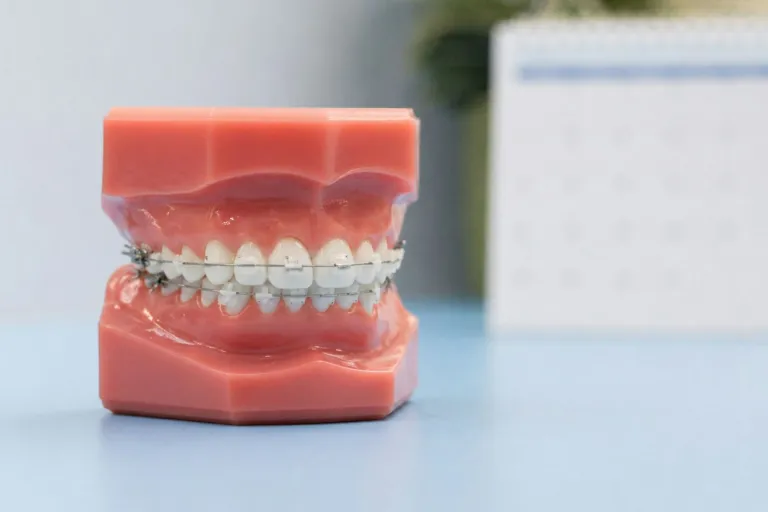
For several months, often twelve to eighteen, the teeth are aligned on each jaw separately, so that they fit together properly once the jaws have been repositioned. During this phase, the bite may look worse than at the start: this is normal, the mismatch is “unmasked” so that it can be corrected. This preparation is most often done with braces; aligners are sometimes possible depending on the case.
2. The operation
The surgeon repositions one or both jaws and fixes them with small plates. The hospital stay usually lasts a few days, followed by several weeks of soft food and recovery.
3. Orthodontic finishing
A few months of treatment refine how the teeth mesh in the new position of the jaws. This is the post-surgical orthodontics phase. Then comes retention, which stabilises the result.
The timetable at a glance
| Phase | Indicative length | Who is involved |
|---|---|---|
| Assessment and plan | A few weeks | Practitioner following the orthodontics, surgeon |
| Orthodontic preparation | Twelve to eighteen months | Practitioner following the orthodontics |
| Operation and hospital stay | A few days | Maxillofacial surgeon |
| Recovery | Several weeks | Surgeon, then orthodontic check-ups |
| Orthodontic finishing | A few months | Practitioner following the orthodontics |
| Retention | Several years | Regular check-ups |
In all, treatment combining orthodontics and jaw surgery often takes about two years, not counting retention.
On video: orthognathic surgery explained
This educational animation shows how the surgeon repositions the jaw to correct a mismatch.
Why follow-up matters just as much
The result of such treatment relies on coordination between the surgeon and the practitioner who follows the orthodontics: the tooth position prepared before the operation directly determines the bite obtained afterwards. After surgery, regular check-ups make it possible to:
- check healing and the stability of the jaws;
- adjust the brace and elastics over the weeks;
- monitor hygiene, which is harder during recovery;
- detect early any tendency to relapse.
Missed appointments are one of the main reasons a result drifts over time.
Once the brace is removed, retention takes over. The NHS points out that a retainer is needed after orthodontic treatment to stop the teeth moving back to their original position.
Looking after your mouth during recovery
Food
In the first weeks, opening the mouth is limited. Eating usually goes through several stages, set out by the surgical team: liquid or blended at first, then soft, then gradually normal. Protein-rich meals help healing. A blender, straws and nourishing soups are worth preparing before the operation.
Brushing
Brushing is more delicate. A small-headed toothbrush, prescribed mouthwashes and no sugary food between meals limit the risk of cavities and gum inflammation around the braces.
Daily life
Facial swelling is significant in the first few days, then decreases over several weeks. Sleeping with the head slightly raised and applying cold, as advised, helps reduce it. Returning to work, sport and travel follows the surgeon’s instructions. Precise instructions are given by the surgical team and the practitioner who follows you.
Effects and risks to be aware of
Like any surgery, orthognathic surgery involves temporary effects and risks, explained in detail by the surgeon before you decide:
- swelling and bruising, which subside within a few weeks;
- a feeling of numbness in the lip or chin, most often temporary;
- a tendency for the jaws to move slightly back towards their initial position, monitored at check-ups;
- risks inherent in any operation under general anaesthetic.
Clear, written information is part of the decision: you can take time to think and ask for a second opinion.
A decision made together
Treatment combining orthodontics and jaw surgery is long and requires being well informed. At a consultation at the CaliSmile Dental Centre, in Casablanca, the examination and X-rays determine whether your situation calls for orthodontics alone or whether a surgical opinion would be useful. In that case, you are referred to a maxillofacial surgeon to discuss it.
For routine orthodontic treatment, see the Dental braces and Clear aligners pages, and our article adult orthodontics: aligners or braces; for procedures carried out at the practice, such as wisdom tooth extractions, see the Oral surgery page.
Frequently asked questions about orthodontics and jaw surgery
From what age can jaw surgery be considered?
Usually after growth has finished, around 17 to 18 for girls and a little later for boys. Before that, orthodontics alone can often guide growth.
How long does the whole treatment take?
Often about two years: twelve to eighteen months of orthodontic preparation, the operation, then a few months of finishing. Retention follows for several years.
Does the operation leave visible scars?
Most often, the operation is done from inside the mouth, with no scar on the face. The surgeon explains the technique planned in your case.
Can the surgery be prepared with aligners?
In some cases, yes, but braces are still most often used, because they also allow elastics and anchor points to be attached, which are useful at the time of the operation.
Is jaw surgery painful?
It is done under general anaesthetic. In the following days, discomfort and swelling are the main issues; they are managed with medication prescribed by the surgical team.
When can I go back to work?
It depends on the operation and your job; several weeks off is common. The surgeon tells you the time suited to your case.
Is jaw surgery covered by insurance?
It depends on your insurance and on the reason, functional or not. The surgeon and the hospital give you a quote; check with your insurer before the operation.
Can the mismatch come back after surgery?
A slight tendency to relapse is possible; it is monitored at check-ups. Orthodontic finishing and retention help stabilise the result.
This article gives general information; it does not replace a consultation.