Implants
Implant or bridge: which to choose when a tooth is missing?
Neighbouring teeth, bone, timescales, upkeep, contraindications: the real differences between an implant and a bridge, without jargon, and how the decision is made.

Reviewed by Dr Badr Salhi, dental surgeon
Published on 8 October 2026 · 10 min read

When a tooth is missing, two fixed options are usually offered: an implant or a bridge. Both replace the tooth for the long term and do not come out. Yet they work on very different principles, with consequences for the neighbouring teeth, for the bone and for the timetable. Here is how to choose between an implant or a bridge, and why the answer depends on your mouth.
Contents
Why replace a missing tooth?
A missing tooth is not just a visible gap. Over time, the mouth adapts, and rarely in the right direction:
- the neighbouring teeth tilt into the gap, which creates areas that are hard to clean;
- the opposite tooth over-erupts, moving down (or up) for lack of support opposite;
- chewing shifts to the other side, which wears more;
- the bone shrinks where the root used to be, which makes a late replacement more complicated.
Replacing a missing tooth early enough prevents these movements. For a front tooth, appearance also matters, but for a molar it is above all the balance of the mouth that is at stake.
Two ways to replace a tooth
The dental implant
A dental implant is a small titanium screw placed in the bone, where the lost root used to be. After a few months of healing, during which the bone fuses with the implant, a crown is fixed onto it. The replaced tooth is independent: it does not rest on any other. The NHS presents the implant as a fixed solution that can replace a single tooth or several.
The dental bridge
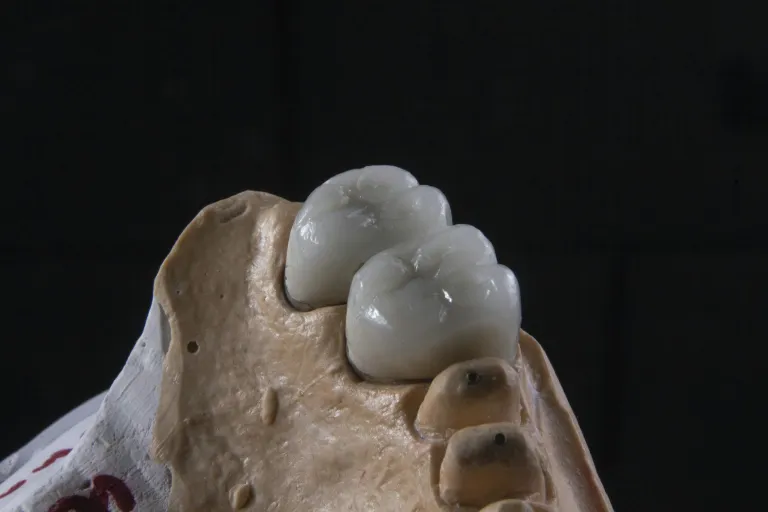
A dental bridge is exactly that: a false tooth suspended between two crowns, bonded onto the teeth on either side of the gap. These teeth act as abutments. No surgery is needed. There are several forms:
- the conventional bridge, on two abutment teeth prepared to receive a crown;
- the bonded bridge, for an incisor, held by small wings bonded to the back of the neighbouring teeth, with very limited preparation;
- the implant-supported bridge, when several teeth are missing: two implants carry three or four teeth.
What changes for the neighbouring teeth
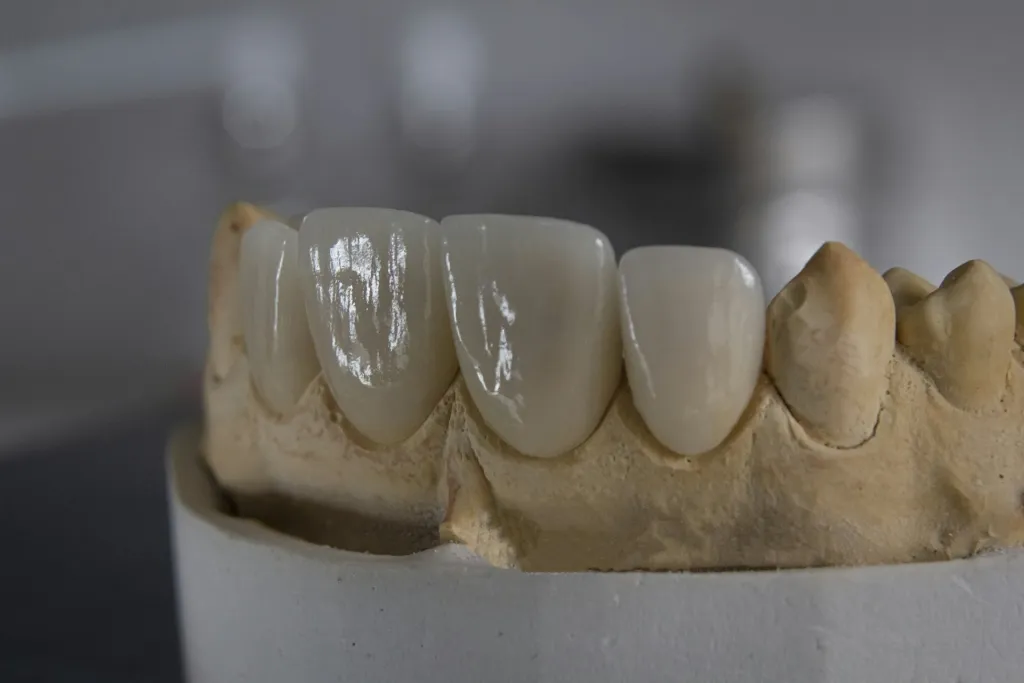
Between an implant or a bridge, this is often the deciding factor. To fit a bridge, the two teeth on either side must be prepared to receive a crown. If they are healthy, intact enamel is therefore removed. If they already have large fillings or crowns, this is not a drawback: the bridge protects them at the same time.
A dental implant, on the other hand, leaves the neighbouring teeth intact. That is why it is often suggested when the teeth around the gap are healthy.
What changes for the bone
When a root is lost, the bone that supported it is no longer stimulated and gradually shrinks. Under a bridge, this resorption continues: over time, a slight hollow may appear under the false tooth.
A dental implant transmits chewing forces to the bone, like a root. It helps to preserve bone volume at that spot. Conversely, it needs enough bone to start with: this is what the 3D X-ray measures before any decision. If bone is lacking, a graft may be needed, which lengthens the treatment.

Implant or bridge: the comparison table
This table sums up, when replacing a missing tooth, what distinguishes an implant or bridge day to day and over time.
| Implant | Bridge | |
|---|---|---|
| Neighbouring teeth | Left intact | Prepared to receive a crown |
| Surgery | Yes, under local anaesthetic | No |
| Bone under the tooth | Better preserved | Continues to shrink |
| Timescale | Three to six months as a rule | Two to three weeks |
| Cleaning | Like a natural tooth | Cleaning under the false tooth |
| Bone volume needed | Yes, sometimes after a graft | No |
| If one part is damaged | The crown is changed on its own | The whole bridge is involved |
Timescales and number of appointments
How a bridge is made
- Preparation: the abutment teeth are prepared under local anaesthetic, an impression is taken and a temporary bridge is fitted.
- Making: the laboratory makes the bridge in one to two weeks.
- Fitting: the bridge is tried in, adjusted and then cemented. The bite is checked.
How an implant is placed
- Consultation and assessment: examination, 3D X-ray, treatment plan and price explained.
- Preparation, if needed: gum treatment, extraction, sometimes a bone graft.
- Implant placement: under local anaesthetic, in an appointment of about an hour for a single implant.
- Healing: three to six months, while the bone fuses with the implant. A temporary tooth can be planned during this period, depending on the area.
- Crown fitting: impression, then a crown screwed or cemented onto the implant.
If you need a quick solution, for example before an event or a departure, the dental bridge has an advantage. If you can wait, the implant timescale is not usually an obstacle. In some favourable cases, the implant can be placed on the day of the extraction: this is an immediate implant, decided after the examination.
Day-to-day upkeep
A dental implant is brushed like a natural tooth, with an interdental brush or floss on each side. A dental bridge needs one extra step: cleaning under the false tooth with special floss or an interdental brush, because debris builds up there. In both cases, regular check-ups and scale and cleans extend the life of the restoration.
What affects how long they last
Neither an implant nor a bridge lasts for ever, and no one can announce a precise lifespan in advance. Several factors count:
- hygiene: the gum around an implant can become inflamed just as it can around a tooth, and untreated inflammation weakens the bone;
- smoking: it slows healing and increases the risk of losing an implant;
- clenching or grinding: it overloads the crowns; a night guard protects them;
- the abutment teeth: under a bridge, a cavity can develop on an abutment tooth if cleaning is insufficient;
- check-ups: an annual visit picks up a problem before it gets worse.
When the bridge is the right choice
- The neighbouring teeth are already heavily restored or crowned.
- The bone volume is insufficient and you do not want a graft.
- Your state of health makes surgery inadvisable for now.
- You need a result within a few weeks.
When the implant is the right choice
- The neighbouring teeth are healthy and you want to preserve them.
- There is enough bone, or a graft is possible.
- Your general health allows it: well-controlled diabetes is not an obstacle, but smoking increases the risk of failure and must be discussed.
Situations that call for precautions
Some situations do not necessarily rule out an implant, but call for a discussion with your doctor and some preparation:
- poorly controlled diabetes;
- certain bone treatments, in particular for osteoporosis or cancer;
- radiotherapy of the head and neck;
- untreated gum disease, to be treated first;
- pregnancy, during which surgery is postponed.
Always mention your treatments and medical history at the consultation: they count in the choice between an implant or a bridge.
And if several teeth are missing?
When several teeth are missing, other options come in: an implant-supported bridge, or a removable denture, possibly stabilised by two implants. When all the teeth in one jaw are missing, a complete denture, either removable or fixed on implants, is considered. Our article fixed or removable denture details these choices.

Tooth loss remains common: the World Health Organization counts total tooth loss among the main oral conditions, most often the result of untreated cavities and gum disease. Preventing them remains the simplest way to keep your teeth.
On video: implant or bridge compared
This educational 3D animation compares, step by step, replacing a tooth with an implant and with a bridge.
Dental implant in Casablanca: how the decision is made
The choice between an implant or a bridge is not made from a catalogue. At a first 45-minute consultation, Dr Salhi examines the gap, the neighbouring teeth and the gums, then measures the bone with a 3D X-ray if an implant is being considered. He presents the possible solutions in your case, with their advantages, their limits and their duration, then explains the plan and the price. You decide afterwards, with no commitment.
If you live in Europe, our article an implant in Morocco while living in Europe explains how to organise the stays between placement and crown. To find out more, see the Dental implants and Crowns and bridges pages, or the Prices page for indicative amounts.
Frequently asked questions about implants and bridges
Is having a dental implant placed painful?
It is done under local anaesthetic: you do not feel the procedure. In the following days, moderate discomfort and swelling are possible; they are relieved with the prescribed medication and cold.
How long does an implant or a bridge last?
Both can last many years with good hygiene and regular check-ups. Smoking, tooth grinding and insufficient cleaning shorten their lifespan.
Is there an age limit for a dental implant?
There is no maximum age: it is your state of health and the bone volume that count. On the other hand, the end of growth, around 18 to 20, is awaited before placing an implant in a young person.
Can a dental bridge be replaced by an implant?
Yes, when the bridge needs redoing and the bone allows it. The abutment teeth, already crowned, then receive new individual crowns, and the gap is filled by an implant.
What happens if there is not enough bone?
A bone graft can rebuild the volume, sometimes at the same time as the implant is placed, sometimes a few months before. If you do not want a graft, the bridge remains an option.
Does a dental bridge damage the abutment teeth?
It requires them to be prepared, which is irreversible. If they are healthy, that is a drawback; if they are already heavily restored, the bridge protects them. Good cleaning under the bridge limits the risk of cavities on the abutments.
Can I leave a gap without replacing the tooth?
It is possible, but the neighbouring teeth may tilt and the opposite tooth may move. For a back tooth, the examination tells you whether the balance of the mouth allows it. If in doubt, it is wiser to discuss it before the bone shrinks.
This article gives general information; it does not replace a consultation.