Implants
Dental crown: zirconia or ceramic?
Strength, appearance, back or front teeth, bruxism, price: what sets a zirconia crown apart from a ceramic crown, and how the choice is made.

Reviewed by Dr Badr Salhi, dental surgeon
Published on 5 November 2026 · 8 min read
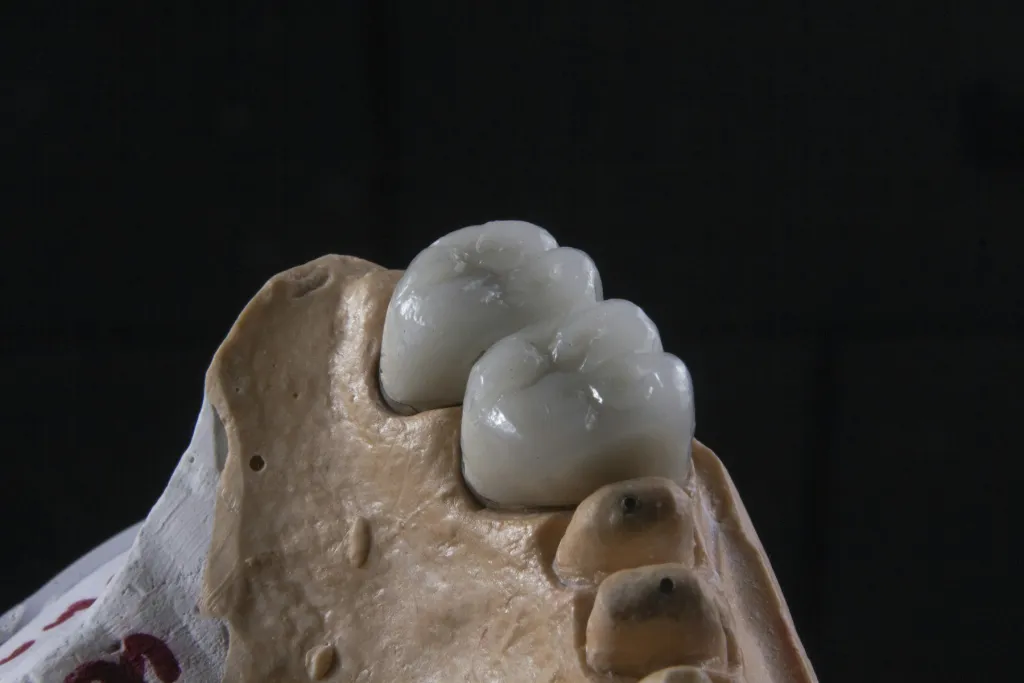
A crown completely covers a damaged tooth to protect it and restore its shape: the NHS describes it as a cap fixed onto the tooth. At the CaliSmile practice, crowns are made without metal, in zirconia or in ceramic. Both last many years when they are well fitted and looked after; they differ in strength, in appearance and in the teeth they suit. This guide compares the two materials, says a word about the porcelain-fused-to-metal crowns that many patients already have, and explains how the choice is made.
Contents
When is a crown needed?
A crown is offered when a simple filling is no longer enough to protect the tooth:
- a devitalised tooth, more fragile after a root canal treatment;
- decay or a fracture too large for a filling;
- an old crown or a large filling that is breaking down;
- a tooth that supports a bridge, or an implant that needs its tooth.
The choice between a crown, a bridge, an implant or a simple filling is made at the examination, with an X-ray. The crowns and bridges page describes how the appointments go.
A crown, a veneer or a simple filling?
A crown is not always needed. A small cavity is treated with a filling, in tooth-coloured composite; gum disease is treated first, before any crown. When only the visible side of a front tooth needs correcting, its colour or shape, a veneer may be enough: it covers only the front of the tooth. Our article ceramic or composite veneers compares these two options.
When a tooth is missing, the crown becomes a bridge, resting on the neighbouring teeth, or is placed on an implant: our article implant or bridge helps you choose.
The zirconia crown
Zirconia is a very strong, metal-free ceramic, white in colour. It is milled from a block by the dental laboratory, from the digital impression of your teeth: a camera replaces the impression paste.
- Its strengths: high resistance to chewing, including on the molars; no metal, so no grey shadow near the gum; well tolerated by the gum.
- Its limits: zirconia used on its own is a little less translucent than a fine ceramic. For the front teeth, it is often covered with a layer of ceramic, which looks more natural but can chip in case of an impact or severe bruxism.
- Who it is for: back teeth, bridges, crowns on implants, and people who clench or grind their teeth.
The metal-free ceramic crown
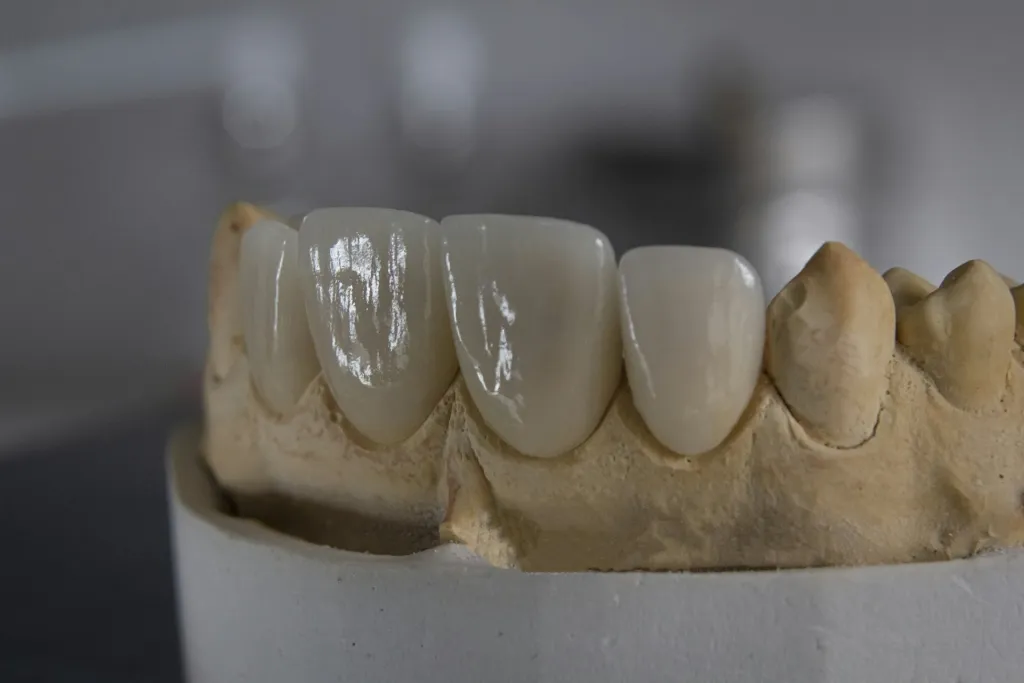
So-called “glass” ceramic lets light through like enamel. It is the material that looks closest to a natural tooth.
- Its strengths: a very natural look, a shade matched to your neighbouring teeth, no metal.
- Its limits: it is a little less strong than zirconia under heavy forces, on the molars or in case of bruxism.
- Who it is for: incisors, canines and visible premolars, when appearance matters most.
And the porcelain-fused-to-metal crown?
It is a metal alloy framework covered with ceramic. For a long time it was the most commonly fitted crown, and many patients have one. It is strong, but metal does not let light through: if the gum recedes over the years, a grey line can appear at the edge of the crown.
The CaliSmile practice makes its crowns without metal, in ceramic or in zirconia. An old porcelain-fused-to-metal crown can be kept as long as it is in good condition; it is replaced if it is damaged, comes loose, lets decay in, or if the grey line bothers you.
Zirconia or ceramic: the comparison
| Zirconia | Metal-free ceramic | Porcelain-fused-to-metal | |
|---|---|---|---|
| Strength | Very high | Good | High |
| Appearance | Natural, a little more opaque on its own | The most natural | Good, grey line possible |
| Metal | No | No | Yes |
| Teeth concerned | Back and front, bridges, implants | Front teeth and premolars | Mainly back teeth |
| With bruxism | Suitable, with a night guard | To avoid on the molars | The ceramic can chip |
| At the CaliSmile practice | Yes | Yes | No (metal-free crowns) |
These are general guidelines. The choice takes into account the tooth, the space available, the way you bite and the condition of your gums.
Step by step, appointment by appointment
- The examination: X-ray, choosing the type of crown with you, and a treatment plan with its price.
- Preparation, under local anaesthetic: the tooth is prepared, a digital impression is taken and a temporary tooth is fitted.
- Manufacture by the dental laboratory, in the shade of your teeth, within one to two weeks.
- Fitting: try-in, adjustment of how the teeth meet, then final fitting. A check-up is planned 15 days later.
Living in Europe? The two appointments usually fit into a stay of one to two weeks, with dates set before you arrive: the patients from Europe page explains how to prepare your trip.
How the choice is made at the practice
At the examination, Dr Salhi looks at the tooth to be covered, its neighbours and the opposite tooth, the condition of the gum and the X-ray. He presents the possible materials for your case, with their advantages, their limits and their price. If you clench or grind your teeth at night, he takes it into account: our article on bruxism explains how a night guard protects crowns as well as natural teeth.
The shade is chosen in daylight, with a shade guide, to match your neighbouring teeth. For the front teeth, a try-in before fitting is used to approve the shape and colour.

How much does a zirconia crown cost?
At the CaliSmile practice, a ceramic or zirconia crown costs 3,000 to 3,500 MAD per tooth, depending on the ceramic; a three-unit bridge, 9,000 to 10,500 MAD. These price guides are published on the Prices page; the exact amount is given to you after the examination, before any treatment.
Fixed dental prostheses are among the treatments reimbursed by the AMO, within the limits of each fund. Our guide to dental care reimbursement sets out the CNSS and CNOPS rules.
Making a crown last
- Brush your teeth twice a day, paying attention to the edge of the crown, against the gum.
- Use floss or an interdental brush every day between the crown and its neighbours: that is where new decay can form.
- Avoid biting hard objects (ice cubes, fruit stones, pens) with the crowned tooth.
- Wear your night guard if you have one.
- Have the crown checked once or twice a year, with a scale and polish.
A crown can be replaced if it is damaged, comes loose or its shade no longer matches your teeth. An X-ray first checks the condition of the tooth underneath.
Frequently asked questions about zirconia crowns
Does the practice fit porcelain-fused-to-metal crowns?
No. The practice makes its crowns without metal, in ceramic or in zirconia; the choice is made with you after the examination. An old porcelain-fused-to-metal crown in good condition can be kept.
Should zirconia be preferred to ceramic?
No material suits every tooth. Zirconia withstands heavy forces better, on the molars or in case of bruxism; metal-free ceramic gives the most natural look on the front teeth. The choice depends on the tooth and the way you bite.
Can a zirconia crown be seen?
No, it is white and metal-free. On its own, it is a little more opaque than a fine ceramic; for the front teeth, a layer of ceramic makes it look more natural.
How long does a zirconia crown last?
Many years when it is well fitted and looked after. Brushing along the gum line, floss or interdental brushes and check-ups matter as much as the material.
Can a zirconia crown be placed on an implant?
Yes. Zirconia and ceramic are used for crowns on implants; the material is chosen according to the position of the tooth. The dental implants page explains how the treatment goes.
How many appointments does a crown take?
Usually two, one to two weeks apart: preparing the tooth, then fitting the crown. In between, you wear a temporary tooth.
Does a zirconia crown hurt?
The tooth is prepared under local anaesthetic; fitting the crown rarely needs it. Sensitivity to hot or cold is possible for a few days.
This article gives general information; it does not replace a consultation.