Emergencies
Dental abscess: symptoms, what to do and how it is treated
How to recognise a dental abscess, what you can do while waiting for your appointment, the signs that mean you should be seen without delay, and the treatment at the practice.

Reviewed by Dr Badr Salhi, dental surgeon
Published on 27 October 2026 · 9 min read

A dental abscess is a pocket of pus that forms at the tip of a tooth’s root or in the gum, following an infection. It often causes throbbing pain, a tooth that is sensitive to the slightest touch and, sometimes, a swollen cheek. It does not heal on its own: the cause must be treated at the practice. This article explains how to recognise it, what you can do in the meantime, the signs that mean you should be seen without delay, and how it is treated.
Contents
What is a dental abscess?
Bacteria in the mouth can only reach the inside of a tooth through an opening: deep decay, a crack, an old filling that no longer seals properly. They then infect the nerve (the pulp), which eventually dies. The infection travels down the root and comes out at its tip, into the bone. The body reacts by enclosing it in a pocket of pus: this is the abscess.
There are three situations, which are not treated in the same way.
Abscess at the tip of the root
This is the most common. It affects a tooth whose nerve has died or is dying, often after old decay or a severe toothache that calmed down without treatment. The medical term is periapical abscess.
Gum abscess
It forms in a pocket between the gum and the root, when gum disease has set in. The tooth may be healthy inside. Gums that have been bleeding for a long time are often the starting point; treatment falls under periodontology.
Abscess around a wisdom tooth
A partly erupted wisdom tooth traps debris under the gum, which becomes infected. The pain is at the back of the jaw and sometimes makes it hard to open the mouth. The X-ray shows the position of the tooth; extraction falls under oral surgery.
Symptoms of a dental abscess
The signs vary from one person to another, but some come up often:
- throbbing, constant pain, sometimes spreading to the ear, temple or neck;
- a tooth that hurts when you bite or touch it, with the feeling that it is “higher” than the others;
- red, swollen gum near the tooth, sometimes with a small white or yellow spot;
- an unpleasant taste in the mouth, or new bad breath;
- a swollen cheek or swelling under the jaw;
- fever, tiredness, tender glands under the jaw.
The small spot on the gum is called a fistula: it is a channel through which the pus drains. When it bursts, the pain often drops suddenly. This relief is misleading: the infection continues at the tip of the root.

Dental abscess: what to do while waiting for your appointment?
These steps bring relief, but do not treat the abscess. Call the practice at the first signs.
- Take paracetamol at the dose shown on the leaflet. For a dental infection, the French medicines agency recommends paracetamol first: anti-inflammatories such as ibuprofen can mask how the infection is developing. Ask your pharmacist for advice if you take other medication.
- Apply cold to the cheek, never directly on the skin: an ice pack wrapped in a cloth, fifteen minutes, then a break.
- Rinse your mouth with warm salt water, gently, several times a day.
- Brush your teeth as usual, with a soft brush around the painful area.
- Eat soft, lukewarm food, on the other side, and drink regularly.
- Sleep with your head raised: pressure in the infected area decreases.
An abscess does not heal with medication alone: treating the tooth or the gum is what removes the infection.
What not to do
- Bursting the abscess yourself, with a needle or by pressing on it: you risk spreading the infection.
- Putting heat on the cheek: heat can encourage the swelling to spread.
- Taking antibiotics from an old prescription: the product, dose and duration may not be suitable, and the wrong treatment masks the signs without dealing with the cause.
- Placing aspirin against the gum: it burns the lining of the mouth.
- Waiting because the pain has gone: a draining fistula or a dead nerve no longer hurts, but the infection progresses.
When to see a dentist urgently?
Call the practice the same day if:
- the pain does not respond to paracetamol;
- the gum, the cheek or the area under the jaw swells;
- you have a fever;
- you find it hard to open your mouth.
Swelling spreading towards the eye or neck, difficulty swallowing or breathing, a high fever with shivering: go to hospital emergency services straight away.
These signs show that the infection is spreading to the tissues around the jaw. This is known as cellulitis of dental origin: it needs prompt treatment, sometimes in hospital. These complications are rare when the abscess is treated in time.
How the dentist treats a dental abscess
Examination and X-ray
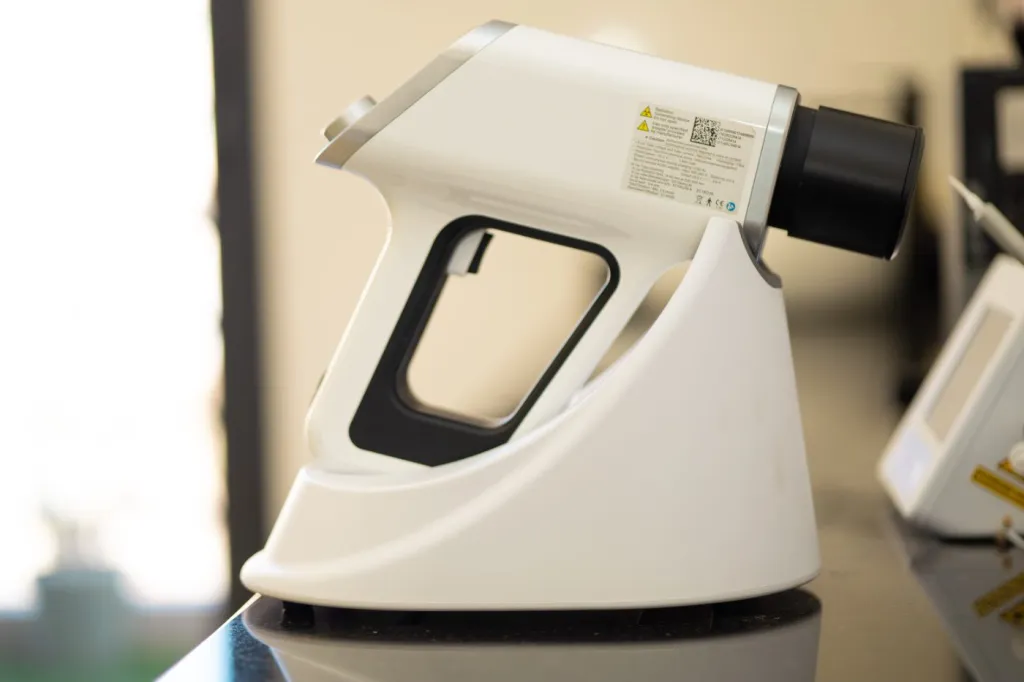
Dr Salhi asks about the pain, examines the gum and tests the teeth with cold and gentle tapping. A digital X-ray shows the tooth involved, how far the infection has spread around the root and the condition of the bone. It helps decide between keeping the tooth and extracting it.
Draining the abscess and relieving pain
The first step releases the pus and lowers the pressure, under local anaesthetic: by opening the tooth to clean the inside of the root, or through a small incision in the gum. The pain usually eases within hours; the swelling, within a few days.
Treating the cause
- When the tooth can be kept, treatment continues with a root canal treatment: the canals are cleaned, disinfected and then filled, in one or two appointments. The tooth, more fragile afterwards, is often protected with a crown.
- When the abscess comes from the gum, the pocket is cleaned in depth, then the gums are followed up to prevent it coming back.
- When the tooth cannot be kept (fractured root, tooth too damaged), it is extracted. The options for replacing it, an implant, a bridge or a removable denture, are discussed afterwards, without rushing.
Each step and its price are explained to you before they are carried out.
Antibiotics: useful, but not always
Antibiotics do not replace treatment: they do not reach the inside of a tooth whose nerve has died. They are prescribed after the examination when the infection is spreading (swelling, fever, tiredness), or when treatment has to be postponed. The British NHS gives the same rule: an abscess is treated first by draining the pus and treating the tooth.
Dental abscess in children and during pregnancy
In children
Decay progresses quickly in a baby tooth, whose enamel is thinner. An abscess can appear without the child complaining much: a swollen cheek, a spot on the gum or refusing to chew should alert you. Treating an infected baby tooth protects the permanent tooth forming underneath. The children’s dentist page explains how treatment goes for younger patients.
During pregnancy
An abscess must be treated, pregnant or not: the infection is riskier than the treatment. Mention your pregnancy when you book: the local anaesthetic, the X-ray with protection and the medication are chosen accordingly. Do not take any medication without advice, even a common one.
Preventing an abscess from coming back
Most abscesses come from decay that progressed silently, or from untreated gum disease. According to the World Health Organization, tooth decay and gum disease are among the most widespread conditions, and are largely prevented by simple habits.
- Brush your teeth twice a day, for two minutes, with a fluoride toothpaste.
- Clean between your teeth every day, with floss or interdental brushes.
- Have a check-up and a scale and polish once or twice a year.
- Do not ignore sensitivity to cold or sugar: our article on tooth decay explains how it develops.
A tooth that has had an abscess and has been treated with a root canal is checked by X-ray a few months later, to make sure the bone is rebuilding.
A dental abscess in Casablanca: who to call?
The CaliSmile Dental Centre, in the Californie district, sees emergencies on call, seven days a week: during the day within practice hours, then until 1 a.m. Call 06 51 51 54 56: describing your symptoms means you can be seen quickly. For an emergency, only the treatment carried out is charged, with no consultation fee; price guides are on the Prices page. All the practical information is on the Dental emergencies page.

Frequently asked questions about dental abscesses
Can a dental abscess go away on its own?
No. The pain may ease, especially if the pus drains through a small spot on the gum, but the infection remains at the tip of the root or in the gum. Without treatment, it comes back or spreads.
How long does a dental abscess last?
Without treatment, it flares up again and again for weeks. Once the abscess has been drained and the tooth treated, the pain usually eases within a few hours and the swelling goes down within a few days.
Is an antibiotic enough to treat a dental abscess?
No. An antibiotic can calm the infection for a while, but it does not act on its cause, inside the tooth or in the gum pocket. It is prescribed after the examination, alongside treatment, when the infection is spreading.
Is a dental abscess dangerous?
It becomes so if it is not treated: the infection can spread to the tissues of the cheek and neck. Swelling that spreads, difficulty swallowing or breathing, or a high fever need immediate care, at hospital emergency services if necessary.
Does a tooth that has had an abscess have to be pulled out?
Not necessarily. Most often, the tooth can be kept thanks to root canal treatment. Extraction is offered when the root is fractured or the tooth can no longer be rebuilt.
Can a dental abscess be treated in the evening?
Yes. The practice sees emergencies on call outside its opening hours, until 1 a.m. Call before coming: you will be given a time to come in.
This article gives general information; it does not replace a consultation.