Prevention
What happens at a first consultation with the dentist
Questionnaire, examination, X-rays, written plan: what happens during the 45 minutes, what is useful to bring, and how the consultation goes if you are anxious.

Reviewed by Dr Badr Salhi, dental surgeon
Published on 3 September 2026 · 9 min read

Changing dentist, coming back after several years without a check-up, or seeing a dentist in Casablanca for the first time: a first consultation with the dentist often raises questions. Here is how it unfolds at the CaliSmile Dental Centre, step by step, and how to prepare so that it is useful, including if you feel anxious about the appointment.
Contents
Why a full dental check-up
A first consultation is not just a quick look. It is a dental check-up of the whole mouth, which serves as the starting point for what follows:
- after several years without a check-up, to spot cavities or gum disease that are still silent;
- when changing dentist, to resume follow-up with an overall view;
- when arriving in Casablanca, or during a stay in Morocco;
- for a specific problem, which is examined in the context of the whole mouth.
Most oral diseases can be avoided or treated early: the World Health Organization points out that cavities and gum disease are among the most widespread conditions in the world, even though they are largely preventable. Regular check-ups are the foundation.
A consultation planned to take its time
The first consultation with the dentist lasts 45 minutes at the practice. That time makes it possible to understand your request, examine the whole mouth and explain what has been seen, without rushing. It ends with a treatment plan, which you take away, and the price explained. It does not commit you to anything.
First dental consultation: the 5 steps
- your reason for coming and your health;
- the examination of the mouth;
- X-rays, if needed;
- the explanation of what has been observed;
- the plan and price explained.
Step 1: your reason for coming and your health
Every first dentist appointment starts with a conversation: what brings you, what bothers you, what you expect. A medical questionnaire completes this discussion. It matters for your safety: certain treatments, such as anticoagulants or osteoporosis medication, and certain conditions, such as diabetes, change the way treatment is given. Also mention a pregnancy, an allergy or any particular anxiety. If you have had a bad experience in the past, saying so helps adapt the pace of the appointment.
Step 2: examining the mouth
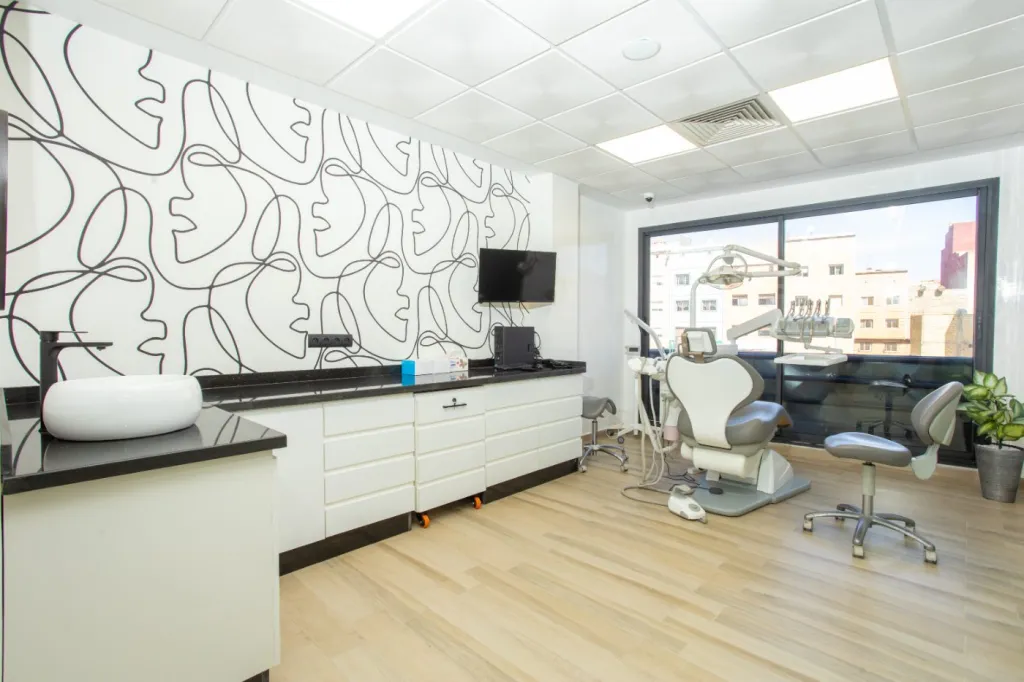
At the heart of the dental check-up, Dr Salhi examines the teeth one by one, the gums, the tongue, the soft tissues and the jaw joint. He looks for cavities, cracks, old fillings to monitor, the condition of the gums and the way your teeth fit together.
In practice, the examination covers:
- the teeth, with a small mirror and a probe, under good lighting;
- the gums, where the depth around each tooth is measured with a graduated probe, a gentle procedure;
- the soft tissues and tongue, looking for any lesion that would need monitoring;
- the bite and the jaw, to spot wear, clenching or discomfort when opening.
Step 3: X-rays, if needed
Depending on what the examination shows, an X-ray may complete the dental check-up: a small image of a specific area, or a panoramic X-ray of the whole mouth. The practice uses low-dose digital X-rays, whose image appears immediately on screen. When an implant is being considered, a 3D X-ray measures the bone volume on site. If you are pregnant, say so: non-urgent X-rays are then postponed.
Step 4: the explanation
This is the most important moment. Dr Salhi shows you the images, explains what he has observed and what does, or does not, need treatment. If there are several solutions, he presents their advantages, their limits and their duration. You can ask all your questions.
A good treatment plan does not start with the most expensive treatment: it starts with what is urgent, then with what protects your teeth in the long term.
Step 5: the plan and price explained
You leave with a dated treatment plan, ranked by priority, and the price of each step. The treatments are grouped into three categories:
- what is urgent: pain, an infection, a broken tooth;
- what protects your teeth: cavities, gum treatment, a scale and clean;
- what can be scheduled later: replacing a tooth, cosmetic work, orthodontics.
You can take time to think, talk it over with your family, or ask for another opinion. If urgent treatment is needed, for example for a painful tooth, it can be done the same day with your agreement.

On video: your first visit to the dentist
This educational animation sums up what happens at a first visit to the dentist, from reception to the treatment plan.
What is useful to bring
For an efficient first consultation with the dentist, remember to bring:
- your recent X-rays and reports of previous treatment;
- the list of your medicines, or your prescriptions;
- your questions, written down in advance so as not to forget anything;
- your brace or aligner, if you wear one.
If you are afraid of the dentist
Fear of the dentist is common and nothing to be ashamed of. Say so when you book or when you arrive: the consultation goes at your pace, every step is announced before it is done, and you can ask for a break at any time by raising your hand. The first dentist appointment often includes no treatment at all, only an examination and a conversation.
A few simple tips also help:
- choose a time when you are not in a hurry, often the morning;
- come with someone, if that reassures you;
- ask your questions about the anaesthetic before any treatment: it often starts with a numbing gel, followed by a slow injection.
Hygiene and sterilisation
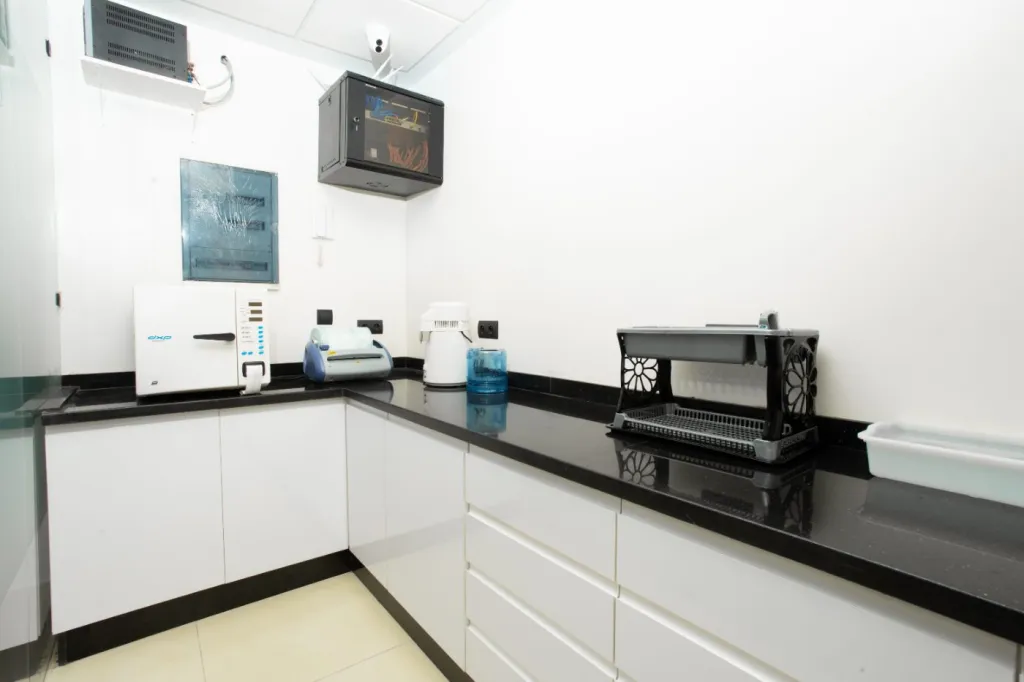
After each patient, instruments are cleaned, packaged and sterilised in an autoclave in a dedicated room, and single-use items are thrown away. The chair surfaces are disinfected between appointments. You can ask any questions you have about this: knowing how hygiene is managed is part of feeling at ease.
What about children?
For a child, the first visit ideally takes place as soon as the first teeth appear, and at the latest at around three. It mainly helps them get used to the practice, checks their teeth and gives parents advice on brushing and diet. Children’s visits are presented on the Children’s dentist page.
After the first consultation with the dentist
Once treatment is complete, a regular check-up, every six months to a year depending on your mouth, keeps it healthy and treats early anything that appears. The French Assurance Maladie (page in French) advises a dental check-up at least once a year. A scale and clean is often combined with this check-up. For what comes next, our articles on tooth decay and bleeding gums explain the most common problems.
First dental consultation in Casablanca: what makes it useful
A useful first dental consultation is one you leave knowing exactly where you stand. At the CaliSmile Dental Centre, a few principles guide it:
- treatment followed by Dr Salhi, from the dental check-up through to care;
- explanations using the images of your mouth, rather than technical terms;
- a written plan ranked by priority, which you can show to another dentist;
- no non-urgent treatment on the same day without you having had time to decide.
If you live in Europe, the Patients from Europe page explains how to prepare this consultation remotely.
Booking an appointment
The practice is open Monday to Friday, 8 am to 7 pm, and on Saturday from 8 am to 1 pm, in the Californie district. You can request an appointment online, by phone or on WhatsApp. The detailed process is also presented on the Your first visit page, and indicative amounts on the Prices page.
Frequently asked questions about the first consultation with the dentist
How long does the first consultation with the dentist take?
About 45 minutes: the discussion about your reason for coming and your health, the examination, X-rays if needed, then the explanation and the written plan.
Do I need to come on an empty stomach?
No. Eat normally and brush your teeth before coming, without trying to hide anything: the examination is not a judgement.
Are X-rays systematic?
No. They are only taken if the examination justifies it, or if you do not have recent ones. Digital X-rays use a low dose.
Can I be treated the same day?
Yes, for urgent treatment such as a painful tooth, with your agreement. Other treatments are scheduled according to the plan, once you have taken time to decide.
Can I bring someone with me?
Yes, a relative or friend can come with you, especially if you feel anxious about the appointment or if important decisions need to be made.
Do I have to follow the proposed plan?
No. The plan and price are proposals. You can think it over, ask for another opinion, or choose to do only part of the treatment, knowing the consequences of each choice.
How often should I come back afterwards?
Usually every six months to a year, depending on the condition of your teeth and gums. Dr Salhi tells you the rhythm that suits your case.
This article gives general information; it does not replace a consultation.